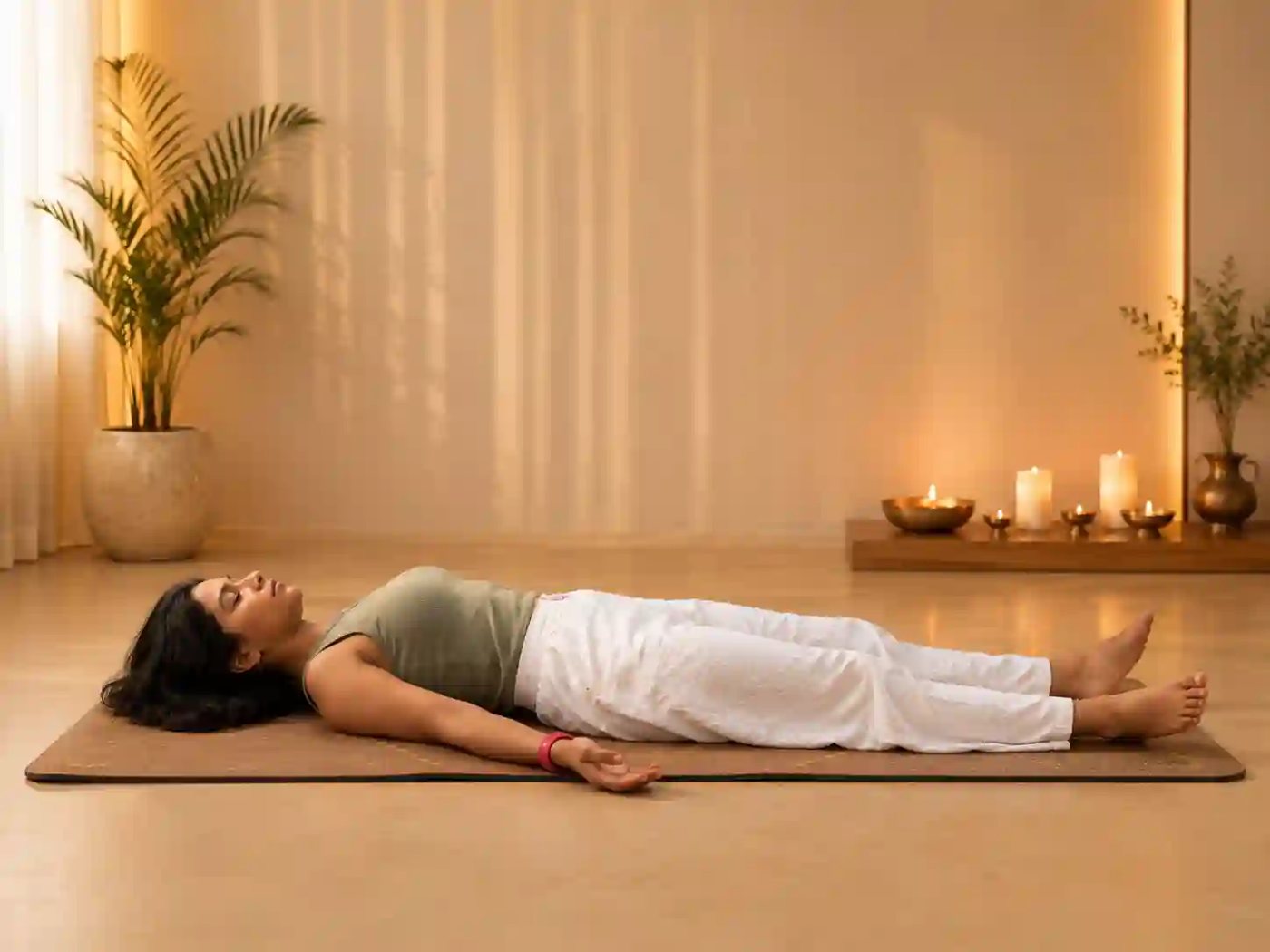
The yogic tradition teaches that there is a state of consciousness between waking and sleeping — a threshold space of profound rest. Yoga Nidra is the intentional practice of dwelling there. For the sleep-deprived modern nervous system, it is nothing short of medicine.
Poor sleep has become one of the defining crises of modern life — and it is rarely just about sleep. It is about a nervous system that has never been given permission to fully switch off, a mind that treats bedtime as an extension of the working day.
Yoga Nidra — “yogic sleep” — does not fight insomnia. It teaches the nervous system to let go, and once that skill is learned, sleep follows. It is the heart of our Yoga Nidra program.
A note before you begin
This is supportive practice, not a medical treatment. Yoga complements your healthcare — it does not replace it. For a diagnosed condition, please practise alongside your doctor’s advice.
What is Yoga Nidra, exactly?
Yoga Nidra is a guided meditation performed lying down in Savasana. It is not sleep — though you may drift in and out, and that is welcome. It is a systematic withdrawal of awareness from the external world, moving through the pancha kosha, the five sheaths of being: the physical, energy, mental, wisdom and bliss bodies. As awareness moves through each layer, tension releases through directed attention rather than effort.
What Yoga Nidra does to the nervous system
- Induces theta brainwave states — the threshold between waking and sleep.
- Reduces cortisol and adrenaline within a single session.
- Activates the parasympathetic nervous system more deeply than most relaxation methods.
- Lowers heart rate and blood pressure measurably.
- Supports emotional processing, easing the burden the mind carries into sleep.
One hour of Yoga Nidra is said to provide the rest of four hours of ordinary sleep. Whether or not you accept that measure, the felt experience is unmistakable.
The eight stages of a classical practice
- 1. Preparation. Settling into Savasana; the nervous system is told: you have arrived, nothing is required of you here.
- 2. Sankalpa (intention). A short positive resolve planted when the mind is most receptive — “I am peaceful,” repeated three times.
- 3. Rotation of consciousness. A rapid body scan that disconnects cortical activity and turns awareness inward.
- 4. Breath awareness. Observing or counting the natural breath to quieten mental chatter.
- 5. Pairs of opposites. Feeling heaviness/lightness, warmth/cold — developing the witnessing mind.
- 6. Visualisation. Quick images arise and dissolve, releasing stored emotion.
- 7. Sankalpa, repeated. The intention revisited at a deeper level.
- 8. Externalisation. A gentle return — often omitted when practising for sleep, so you drift naturally into rest.
A simple pre-sleep ritual
- Dim screens 30 minutes before bed — blue light suppresses melatonin.
- Practise 5 rounds of Nadi Shodhana to begin quietening the mind — part of the wider stress & breath toolkit.
- Lie in Savasana under a light blanket and let the body settle completely.
- Set a Sankalpa: “I release this day and welcome deep rest.”
- Use a guided recording of 20–45 minutes; falling asleep during practice is not a failure.
- Do not check the time afterward — roll to one side and drift.
Poses to prepare the body
A brief 10-minute restorative sequence amplifies the effect: Legs-up-the-Wall (5 min), Reclined Butterfly (3 min), Reclined Twist (90 sec each side). Move directly from this into your Yoga Nidra practice for a seamless descent into rest.
Questions, answered
What is Yoga Nidra?
Can Yoga Nidra replace sleep?
How often should I practise Yoga Nidra for sleep?
Learn Yoga Nidra with me
Live and recorded yogic-sleep sessions — accessible from anywhere, at whatever time your sleep needs call for.
Explore the Yoga Nidra program