Back pain is not a life sentence. With the right approach — slow, breath-led movement and a little patience — yoga can genuinely change what your back is capable of, starting from the very first session.
If you have been told to rest and wait for back pain to pass, I understand the frustration — and the research now supports a different approach. Gentle, targeted movement is almost always more effective than bed rest. Yoga, practised mindfully, does something even more valuable: it addresses not just the muscle tension, but the fear and guarding the body develops around pain.
In this guide I will walk you through the poses I return to again and again with students experiencing back pain — why they work, exactly how to do them, and what to watch out for. These same principles shape our Yoga for Back Pain program, where the sequence below is guided live.
A note before you begin
This is supportive practice, not a medical treatment. Yoga complements your healthcare — it does not replace it. For a diagnosed condition, please practise alongside your doctor’s advice.
Why the back holds so much tension
The lower back is the junction between the upper and lower body. It bears the weight of everything above it and is directly affected by what happens below — tight hamstrings, compressed hip flexors and weak glutes all funnel tension upward into the lumbar spine.
Prolonged sitting is a particularly common culprit. It shortens the psoas (the deep hip flexor that attaches directly to the lumbar vertebrae), creating a constant forward pull on the lower back. Pair that with shallow breathing — which reduces core activation — and you have a near-perfect recipe for chronic back pain.
The back rarely hurts in isolation. Before you treat the symptom, listen to what the hips and hamstrings are saying.
The five poses that create real relief
1. Cat-Cow (Marjaryasana–Bitilasana)
This is the first thing I offer any student with a sore back. Cat-Cow mobilises every vertebra in the spine while breath synchronisation activates the deep postural muscles that provide support.
How to practise: Come to all-fours, wrists under shoulders, knees under hips. Inhale — drop the belly, lift chest and tailbone (Cow). Exhale — round the whole spine, tuck chin and tailbone (Cat). Move slowly, in sync with the breath, for 12–15 rounds.
2. Child's Pose (Balasana)
Child's Pose creates traction through the lumbar spine while releasing the hip flexors. The forward fold also signals safety to the nervous system, reducing the guarding that amplifies pain.
How to practise: From all-fours, take the knees wide, sink the hips toward the heels and extend the arms forward. Rest the forehead down and breathe slowly into the back body for 2–5 minutes. A cushion under the forehead or a blanket between thighs and calves helps if anything feels strained.
3. Supine Twist (Supta Matsyendrasana)
A gentle twist releases the erector spinae and restores rotational mobility — often the first movement lost in back pain.
How to practise: Lie on your back. Draw the right knee to the chest, then guide it across to the left. Extend the right arm out, look gently right, keep both shoulders grounded. Breathe for 8–10 slow breaths, then switch. It should feel like a gentle unscrew — never a force.
4. Bridge Pose (Setu Bandhasana)
Bridge strengthens the glutes and hamstrings — the muscles that, when weak, transfer load to the lumbar spine — and gently opens the hip flexors without compression.
How to practise: Lie on your back, knees bent, feet flat at hip-width. Press through the feet and lift the hips on an inhale. Hold 5–8 breaths, engaging the glutes without gripping the low back. Lower slowly. Repeat three times. Keep the bridge low if you have SI-joint sensitivity.
5. Legs-Up-the-Wall (Viparita Karani)
This restorative inversion is the single most underrated tool for back pain and full-body recovery. Resting the legs elevated unloads the lumbar spine and shifts the nervous system into rest-and-digest.
How to practise: Sit sideways to a wall, swing the legs up as you lower your back to the floor, arms open at your sides. Close the eyes and breathe naturally for 5–15 minutes — longer is better.
What to avoid
- Deep forward folds with a rounded lumbar spine — these load the discs and can aggravate disc-related pain.
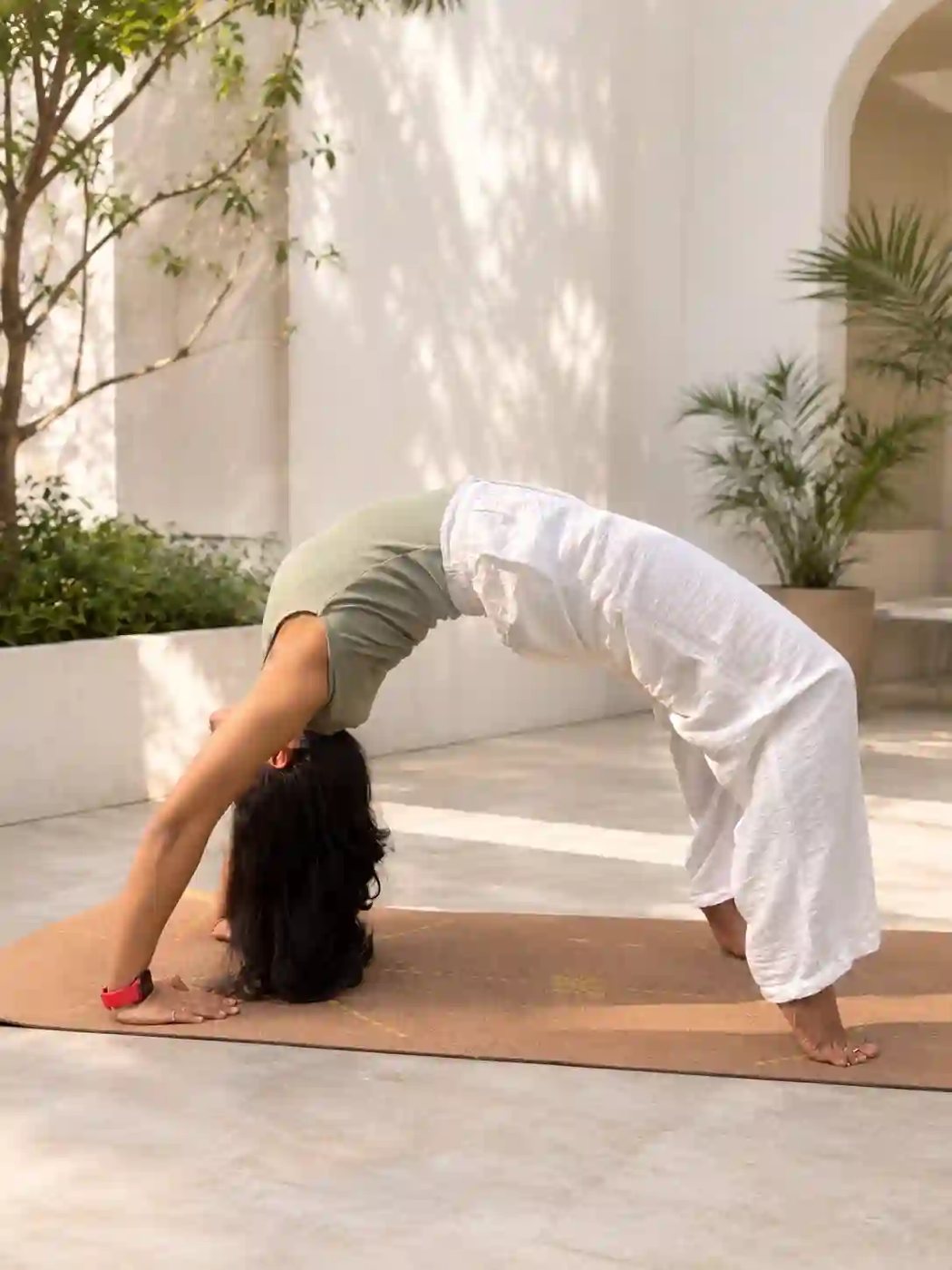
- Deep unsupported backbends (Wheel, full Cobra) — until the acute phase resolves and core strength is established.
- Pushing through sharp or radiating pain — dull stretching is normal; sharp, shooting or electric sensations are stop signals.
- Fast-paced Vinyasa or power yoga during recovery — the nervous system needs slowness to release its guarding pattern.
Your daily 15-minute back-care sequence
- Cat-Cow × 12–15 rounds — 2 min
- Child's Pose — 3 min
- Bridge Pose × 3 rounds — 3 min
- Supine Twist — 90 sec each side
- Legs-up-the-Wall — 5 min
Practise this once daily for two weeks and notice the changes in pain, posture and ease of movement. The body responds to consistency over intensity. If sciatic-type pain travels down the leg, the companion guide on easing sciatica with mindful movement goes deeper on nerve care.
Questions, answered
Is yoga safe for back pain?
Which yoga poses are best for lower back pain?
How quickly will yoga help my back pain?
Practise with a teacher who understands your body
The full back-care sequence — guided live, paced to your body, most days of the week.
Explore the Back Pain program