That burning, electric pain from the lower back into the leg — sciatica is one of the most disruptive things a body can experience. Mindful, unhurried movement is often what it needs most.
If you have ever felt that sharp sensation travelling from your lower back through the buttock and down the back of the leg, you have met the sciatic nerve — the longest in the body. When it is compressed or irritated, it says so in no uncertain terms.
What surprises many people is that the worst thing you can do with sciatica is stop moving entirely. Gentle, breath-led movement — with awareness, zero force and a great deal of patience — is often what releases the nerve and lets healing begin. It is the approach behind our Sciatica program.
A note before you begin
This is supportive practice, not a medical treatment. Yoga complements your healthcare — it does not replace it. For a diagnosed condition, please practise alongside your doctor’s advice.
Understanding what is happening in the body
The sciatic nerve exits the lumbar spine at levels L4 through S3, passes through the pelvis — often directly beneath or through the piriformis in the deep buttock — then travels down each leg to the foot. Compression can occur at the spine (a disc pressing on the nerve root) or at the hip (a tight piriformis). One principle covers both: the nerve needs space, not force.
The piriformis: your most likely culprit
The piriformis is a small, deep hip-rotator buried beneath the glutes. In anyone who sits for long stretches it becomes chronically shortened and begins to compress the sciatic nerve passing beneath it — often called “piriformis syndrome.” This is exactly why slow hip-opening is so effective: you address the primary compressive structure directly.
The sciatic nerve doesn’t want to be stretched aggressively — it wants to be given space gradually. That distinction changes everything about how you move.
Five mindful poses for sciatic relief
1. Reclined Pigeon (Supta Kapotasana)
The safest piriformis release available — lying down means no lumbar compression, only a graduated opening at the outer hip.
How to practise: Lie on your back, knees bent. Cross the right ankle over the left thigh, flex the right foot. If you feel a stretch in the right outer hip, stay. For more, draw both legs gently toward the chest. Breathe for 2–3 minutes, then switch. You should feel it in the outer hip — never shooting down the leg.
2. Knees-to-Chest (Apanasana)
This decompresses the lumbar vertebrae and creates space for the exiting nerve roots. It is where I begin with anyone in an active episode.
How to practise: Lie on your back and draw both knees gently toward the chest, arms around the shins. Let the lower back soften toward the floor; rock gently side to side. Stay for 10–15 slow breaths.
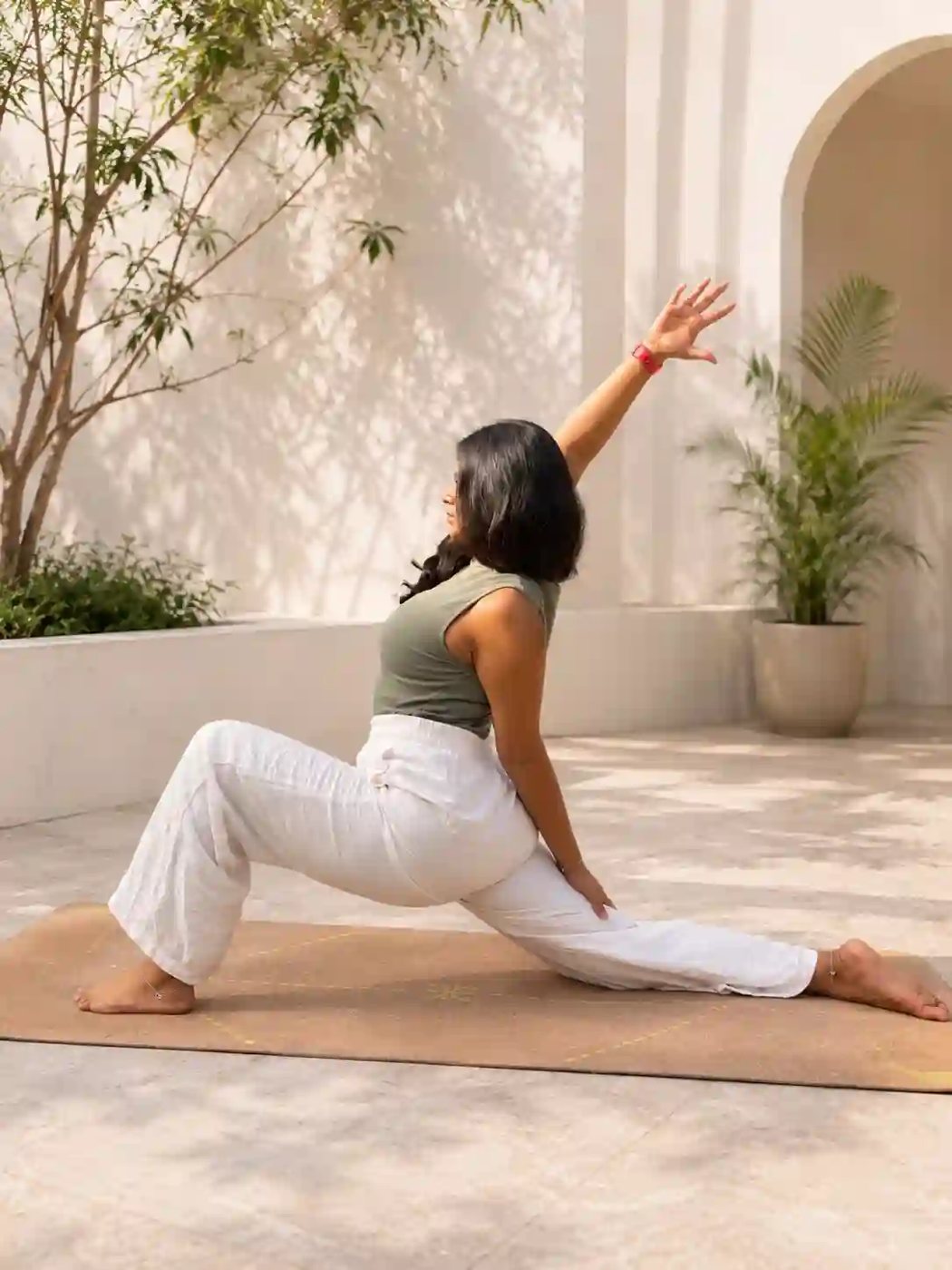
3. Low Lunge (Anjaneyasana)
A tight psoas tilts the pelvis forward, increasing compression on the lumbar discs and nerve roots. Low Lunge addresses this upstream cause directly.
How to practise: From all-fours, step the right foot forward between the hands, lower the left knee (blanket underneath if needed). Sink the hips forward and down, torso upright, for 8–10 breaths. Switch sides. Never trade lumbar safety for depth.
4. Gentle Seated Twist (Ardha Matsyendrasana)
A measured twist mobilises the lumbar vertebrae and can reduce pressure from a disc on the nerve root — with length before rotation, always.
How to practise: Sit with legs extended. Bend the right knee, foot outside the left thigh. Grow tall first; on an exhale rotate gently right, hand to the right knee without forcing. After 6–8 breaths, release and switch. Stop the instant any sensation refers into the leg.
5. Legs-Up-the-Wall (Viparita Karani)
This inversion completely unloads the lumbar spine and shifts the nervous system out of pain-response mode — the most valuable pose in the toolkit during a flare.
How to practise: Sit sideways to a wall, swing both legs up as you lower down, arms open. Breathe naturally for 10–15 minutes, a folded blanket under the hips if helpful.
Four principles of mindful movement
- Slowness above all. Fast transitions aggravate nerve tissue — move as if you have all the time in the world.
- Exhale to deepen. The exhale releases muscle guarding; let it do the work.
- Work below the pain threshold. Stay in “noticeable but comfortable” and back off the moment sensation refers into the leg.
- Consistency over intensity. Twenty gentle minutes daily beats one intense weekly session.
Because nerve pain and stress feed each other, many students pair this with the breathwork in managing stress through yoga & breath to calm the whole system.
Questions, answered
Can yoga help sciatica?
Which poses are best for sciatic pain?
How long until yoga eases my sciatica?
Work with a teacher who understands nerve pain
Personalised, gentle sessions built around your body, history and pace — sciatica and back care included.
Explore the Sciatica program