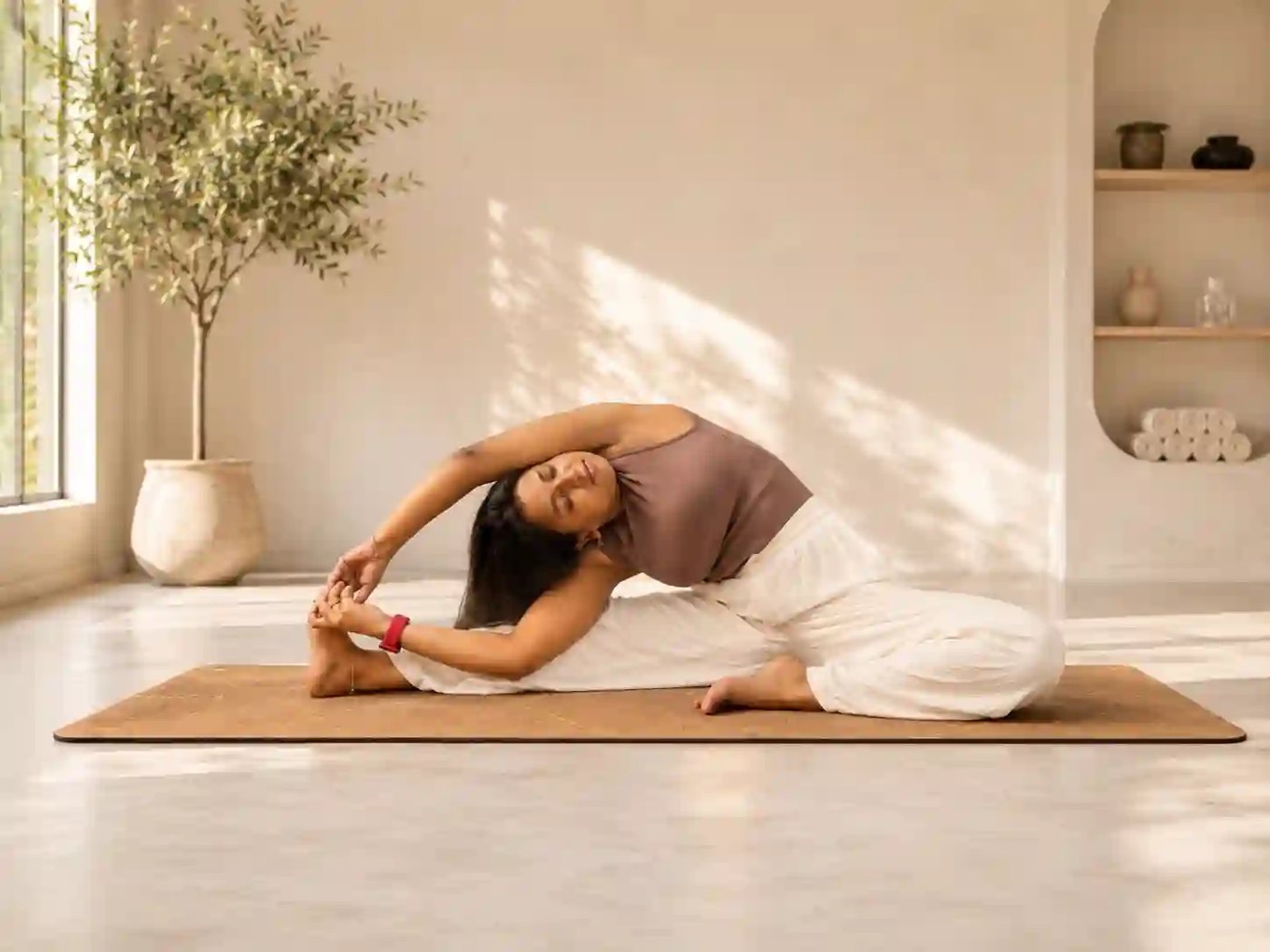
You don’t need an hour on a cushion in the Himalayas. You need ten honest minutes before your phone touches your hand — and a technique built for a mind that has back-to-back meetings, not a monastery schedule.
I hear the same thing from almost every working professional who comes to me: “I know meditation would help. I just don’t have time.” I understand completely — I spent years in corporate life myself before I found stillness. What changed wasn’t finding three free hours a day; it was that I stopped treating meditation as something that required ideal conditions.
This guide is built for full calendars — practical, time-bound techniques that fit into the cracks of a demanding day. They’re the backbone of our Working Professionals track and Meditation & Pranayama classes.
Why the professional mind needs meditation more, not less
Knowledge work is hostile to mental clarity. Constant context-switching keeps the brain in low-grade cognitive load — research on “attention residue” shows even brief task-switching leaves a measurable cost. Add a long commute, late screen time and decision fatigue, and the nervous system rarely downshifts. This is the gap meditation fills: not an escape from the workday, but a recovery tool within it.
What meditation does for a working mind
- Strengthens the prefrontal cortex — focus, planning and calm decisions under pressure.
- Reduces cortisol, improving resilience to back-to-back stressors.
- Improves working memory and attention span — even with 10 minutes daily.
- Increases heart-rate variability, a strong predictor of stress recovery.
- Creates separation between stimulus and reaction — the core of professional composure.
You cannot control your inbox. You can control the half-second between an email landing and your reaction to it. That half-second is where meditation does its work.
Four techniques built for a packed calendar
1. Box Breathing (Desk Reset)
Used by everyone from Navy SEALs to surgeons before high-stakes moments — the fastest way to interrupt a stress spiral. No cushion, eyes can stay open.
How to practise: Inhale 4, hold 4, exhale 4, hold empty 4. Repeat 6–8 rounds, tracing the four sides of a box. Best right before a difficult meeting or whenever the jaw or shoulders tighten.
2. Breath-Counting Meditation
One of the most accessible concentration practices. Counting gives the analytical mind a simple job, which lets deeper layers settle.
How to practise: Eyes closed, count each exhale from one to ten, then begin again. Lost count? Return to one — no self-criticism, just redirection. Continue 5–10 minutes.
3. Trataka — Single-Point Focus
A classical practice traditionally done with a candle flame — it trains the mind to hold a single point, directly transferable to focused work.
How to practise: Gaze softly at a small fixed point — a dot, a flame — without straining for 2–3 minutes, then close the eyes and rest in the after-image for another 2.
4. Walking Meditation (Between Meetings)
All the benefits of mindfulness while the body stays in motion — ideal for a short break between calls.
How to practise: Walk slightly slower than usual. Bring full attention to each footstep — heel, ball, toe. When the mind wanders to the next task, return to the feet. No phone, no podcast.
A realistic day
- 7:00 AM — Breath-counting, 8 min, before checking your phone.
- 11:30 AM — Box breathing, 2 min, before a demanding meeting.
- 1:30 PM — Walking meditation, 6 min, post-lunch reset.
- 4:00 PM — Box breathing, 2 min, the mid-afternoon dip.
- 7:00 PM — Trataka or breath-counting, 10 min, marking the transition out of work.
Under 30 minutes, distributed across the day — no single block required. The professionals who sustain a practice attach it to an existing habit: meditate right after your morning coffee, breathe every time you close your laptop. The anchor habit does the remembering for you.
Questions, answered
How can busy professionals find time to meditate?
What is the best meditation technique for focus at work?
Does meditation actually reduce workplace stress?
Built for people with no time to spare
Live, 20-minute sessions designed around real calendars — Meditation & Pranayama and a Working Professionals track.
Explore the program